
Stage 05 - Living in Retirement
Six years have passed. Jia Wen is now 60, and her husband is 62. After many years of running the family business, they are gradually stepping back from daily work.
Their 28-year-old son is taking on more responsibility in the business, while their daughter, now 31, continues building her own career.
They are enjoying more time together. But now that they are working less, they are facing a new challenge.
Will their savings and other income be enough to support the life they want, without depending too much on the business?

Meet Jia Wen — A Different Rhythm of Life
For many years, Jia Wen’s days were filled with work, family responsibilities and business matters.
There was always something that needed her attention.
Things feel different now.
She has more time to enjoy her morning walks, meet friends for lunch and plan short holidays with her husband.
Her husband still keeps in touch with the business and shares his experience when needed, but he is learning to leave more of the daily decisions to their son.
At first, having more time feels like a reward for all those years of hard work.
But Jia Wen soon notices something interesting.
Even though they are working less, life hasn’t necessarily become less expensive.
There are holidays they want to take, places they want to visit and activities they finally have time to enjoy.
And of course, the usual household expenses continue.
One day, Jia Wen finds herself thinking:
“We’ve worked hard for the freedom to enjoy life. But how do we make sure this freedom can last?”
It’s a question she wants to explore with her husband as they settle into this new chapter of their lives.
A Conversation About Their Retirement Income
One evening, Jia Wen takes out the retirement plan she and her husband prepared a few years ago.
“Remember when we worked out how much we might need for retirement?” she asks.
Her husband smiles. “Of course. We looked at our EPF, savings, investments and properties.”
“But now that we’re working less, our actual spending is different from what we expected,” Jia Wen says.
They review their monthly expenses. Some costs have reduced, while spending on travel, leisure and everyday living continues.
“We still have the business,” her husband says. “And our savings and investments.”
Jia Wen nods. “But what if the business has a difficult year? Our son needs money to run it too.”
Her husband pauses. “Then we shouldn’t rely too heavily on the business for our retirement.”
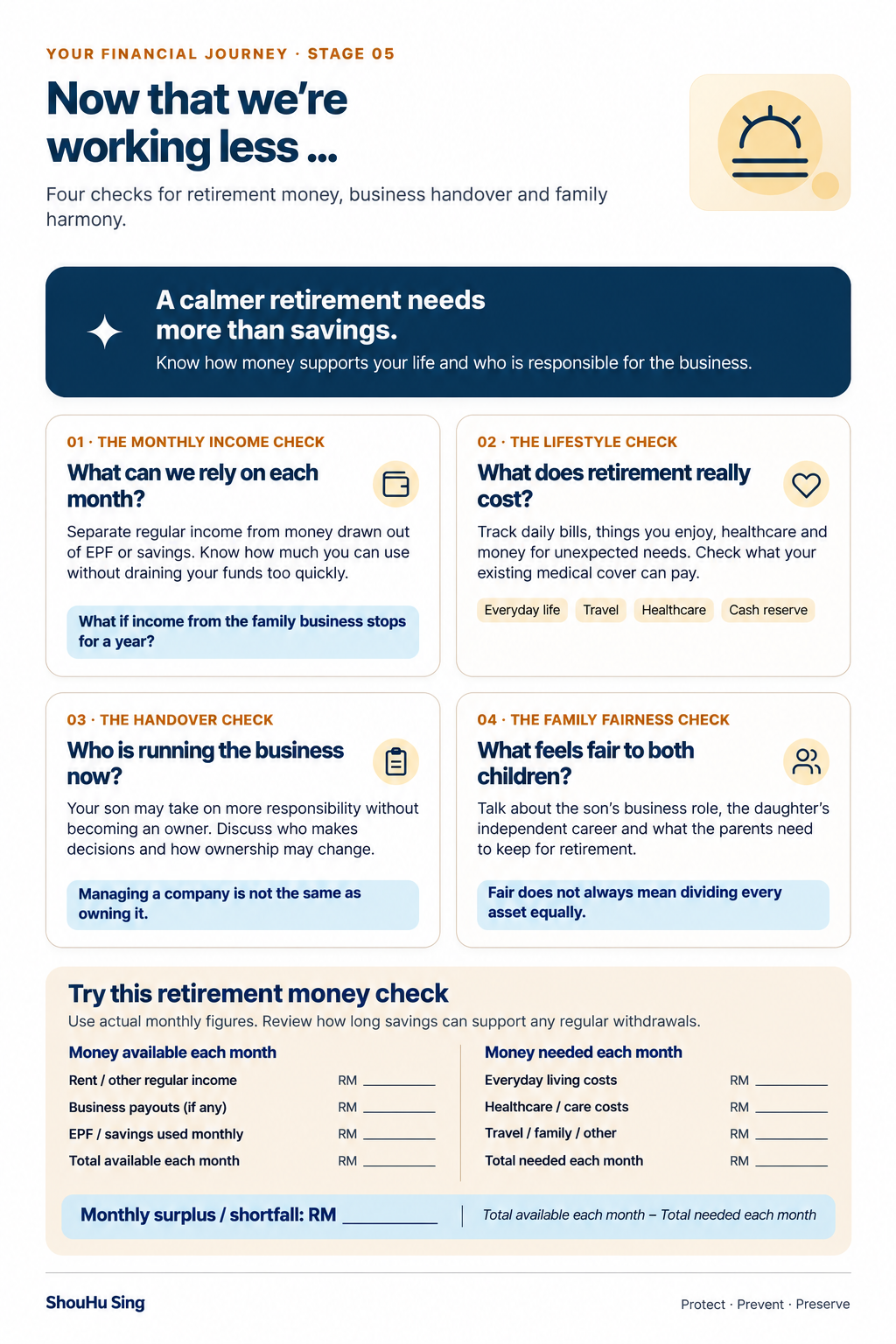
They decide to review how much income they can rely on, how much they may need to withdraw from their savings, and how long those funds could last.
They also consider rising living costs and unexpected expenses.
They realise that preparing for retirement was only the beginning. Now they need to make their money last throughout retirement.
A Question They Hadn't Answered
As their son takes on more responsibility in the family business, Jia Wen and her husband feel more comfortable leaving daily decisions to him.
But one evening, their daughter raises a question.
“If my brother eventually runs the business, does that mean he’ll own it too?”
Her father replies, “We haven’t decided that yet. Right now, we want him to learn how to manage the company.”
“I understand,” she says. “I’m not interested in running the business, but I’d like to know what you have in mind for both of us.”
Jia Wen realises they have spent years preparing for retirement and discussing who will manage the business, but haven’t really discussed how their assets should eventually be passed on.
Their son may take over the business, while their daughter continues her own career. Both have different interests and expectations.
They also need to consider how much of their savings, investments and other assets should remain available for their own retirement.
Rather than rushing into decisions, the family agrees to discuss their wishes and expectations together.
Managing the business, owning the business and treating both children fairly are different decisions — and each deserves careful thought.
What I Wish I Knew When We Started Slowing Down
Looking back, Jia Wen realises that retirement isn’t just about having enough money. It’s also about knowing how to manage the life they have worked so hard for.
1. Our actual spending may be different from what we planned.
We should review what we really spend, not just rely on estimates made years ago.
2. Having assets doesn’t always mean having regular income.
We need to know which assets can provide income and how long our savings may last.
3. Our retirement shouldn’t depend entirely on the family business.
The business needs money to operate and grow. We should have other sources of retirement funding.
4. Passing on business responsibilities is not the same as passing on ownership.
We need to be clear about who manages the business, who owns it and how to treat our children fairly.
5. Retirement planning doesn’t end when we stop working.
Our income, spending, health and family circumstances will change. Our financial arrangements should be reviewed regularly.
A Quick Check for Yourself
Do I know how much money I need each month in retirement, and where that money will come from?
If income from the family business stops for a year or investments perform poorly, can I still cover my essential living expenses?
Do I have enough accessible savings for unexpected healthcare costs and family emergencies?
If a family member is taking on more responsibility in the business, have we clearly discussed their role, decision-making authority and future ownership?
Have we discussed what would be fair to each child while keeping enough money for our own retirement?
THE JOURNEY CONTINUES
More Freedom. A Future Still Taking Shape.
Jia Wen and her husband are enjoying a slower pace of life, while their son takes on more responsibility in the family business.
They’ve learned that retirement is not just about how much they own. It’s about having enough income to enjoy life, while keeping their family’s future in mind.
They haven’t settled every question about business ownership or how their assets should eventually be passed on. But these are conversations they are ready to have together.
As they grow older, another important question begins to emerge:
“If one day we can no longer manage everything ourselves, will our family know what to do?”
Can Your Retirement Income Support the Life You Want?
Stepping back from work changes how your money needs to support you.
Are your income, savings and family arrangements still suited to the years ahead?
We can review what you already have, identify what needs attention and discuss a practical next step.
Michelle Wan · Registered Financial Planner in Melaka