
Stage 01 - Starting Out in Life
Your first salary feels exciting. You can finally spend your own money, make your own decisions, and enjoy a little more freedom.
But as you start working, you may realise something: earning money and managing money are two different things.

Meet Jia Wen - Her First Salary
Jia Wen is 24 and lives in Melaka. She recently started her first full-time job, earning RM3,200 a month before deductions.
When her first salary arrived, she felt proud. After years of studying and depending on her parents, she could finally pay for things herself.
Her employer also contributes to her EPF and provides some medical benefits, but these are not things she pays much attention to yet.
She started thinking about buying a car, treating her parents to dinner and saving for a holiday with friends.
But there was one thing she hadn’t really thought about.
How much of her salary could she actually afford to spend?
Where Did Her Salary Go?
Jia Wen began spending on transport, meals, phone bills and outings with friends. She also wanted to contribute something to her parents every month.
None of these expenses seemed particularly big on their own.
But towards the end of the month, she checked her bank account and was surprised by how little was left.
She hadn’t spent everything on unnecessary things. She simply hadn’t realised how quickly small expenses could add up.
And she was still thinking about buying a car.
Would she really be able to afford the monthly instalment, petrol, insurance, servicing and other running costs?
An Expense She Didn't Expect
One evening, Jia Wen’s laptop suddenly stopped working. She needed it for work, and the repair would cost RM800.
She had enough money in her bank account, but most of it was meant for her upcoming bills.
If she paid for the repair, she might have to use her credit card for other expenses.
That was when she realised something.
Having money in the bank doesn’t always mean that money is available to spend.
She decided to start keeping a separate amount for unexpected expenses, even if she could only put aside a little each month.
What I Wish I Knew When I Received My First Salary
Looking back, Jia Wen would say:
“I didn’t need to figure out everything about money when I received my first salary. I just needed to start with a few simple habits I could keep.”
1. Know what is already committed.
Before spending, check what needs to be paid before your next salary.
2. Keep something for unexpected expenses.
Even a small amount saved regularly can make an unexpected bill easier to manage.
3. Think beyond the monthly instalment.
Buying a car also means paying for petrol, insurance, servicing and repairs.
4. Start with what you can comfortably afford.
Saving RM100 or RM200 regularly is a practical beginning if it fits your situation.
5. Review your financial arrangements as life changes.
At least once a year, check whether your income, spending, savings and employment benefits still meet your needs. Keep your bank, EPF, insurance and nomination records organised, especially when changing jobs or taking on new financial commitments.
A Quick Check for Yourself
Before taking on bigger financial commitments, ask yourself:
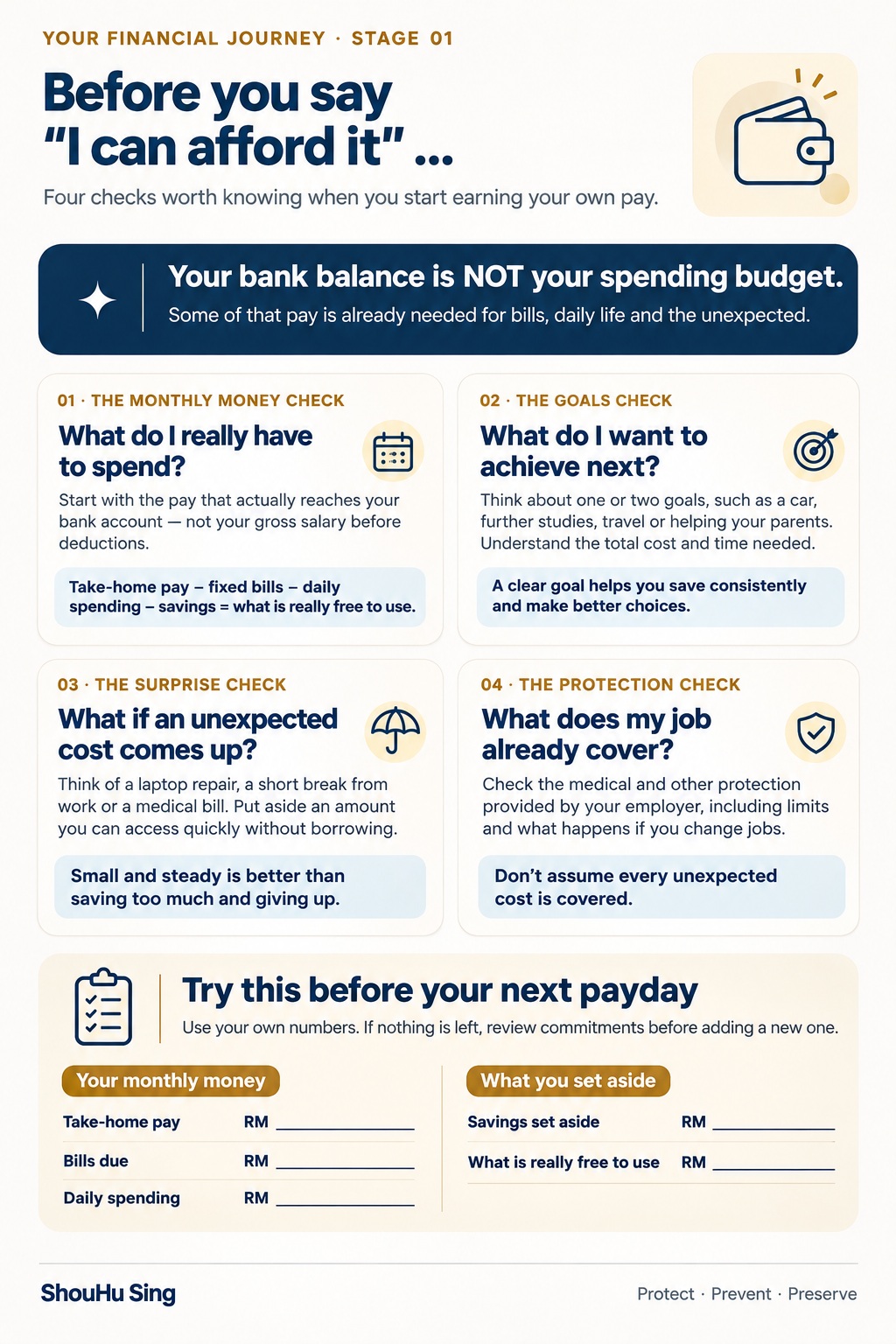
My Monthly Money — Do I know how much of my take-home pay is left after bills, daily spending and savings?
My Big Purchases — Before committing to a car loan or another major purchase, have I considered the full cost, not just the monthly instalment?
My Emergency Savings — If an unexpected RM800 bill arrives tomorrow, or my salary stops temporarily, could I manage without borrowing?
My Employment Benefits — Do I understand my employer’s medical benefits, protection and EPF contributions, including what changes if I leave my job?
My Future Readiness — Have I identified a financial goal for the next 1–3 years and kept my important financial records organised?
You don’t need every answer today.
Start by understanding where you stand, choose one affordable next step and review your progress as life changes.
THE JOURNEY CONTINUES
Every stage starts with small choices.
Jia Wen doesn’t need to have everything sorted out at 24. But the choices she makes now will shape what she can do when work, family and responsibilities change.
Want to talk through your own starting point?
Perhaps you are starting work, or someone in your family is. We can look at what matters first and what can wait.
Michelle Wan · Registered Financial Planner in Melaka